

The bottle sat in my kitchen cabinet for three weeks before I opened it. I had bought it, read half the label, and then second-guessed myself into leaving it there behind the tea. Which serving? What time of day? With food or without? I am not a doctor, a nutritionist, or a pharmacist, so I did what I usually do these days. I asked my own doctor, and then I built the smallest possible routine around the answer.
That bottle was Doctor's BEST High Absorption Magnesium Glycinate, the 240 count tablets, 200 mg per serving. I have taken it for about two years now, two tablets after dinner, and it has become the least interesting part of my evening, which is exactly what I wanted. What follows is how I fit it into a daily routine, step by step, for anyone holding an unopened bottle and the same three questions I had.
The bottle I finally stopped second-guessing
240 tablets, 200 mg per serving, 100% chelated and not buffered with fillers or additives. It is the one that stayed in my cabinet after the first two weeks of arguing with myself.
Amazon Check Today's Price on Amazon →Step 1: Read the whole label before you read a single review
The first thing I do with any bottle is turn it around. The front of a supplement bottle is advertising. The back is the part that has to be true. I learned that from years of reading ingredient lists at the dental office, and it has saved me more money than any coupon.
On the Doctor's BEST panel, the facts I could check for myself were these: 200 mg per serving, tablet form, 100% chelated, and not buffered with fillers or additives. The listing adds vegan, non-GMO, gluten-free and soy free. Those are the lines I wrote on a sticky note on the inside of the cabinet door, because in month four I will not remember any of it.
The line I would circle twice is the serving size. A milligram number on the front of a box means nothing until you know how many tablets make up a serving, and it is not always one. I have picked up bottles where a serving was two tablets and bottles where it was three. Read that line, then read how many servings are in the bottle, and you will know what the count on the label actually buys you.
I also read the absorption claim with a raised eyebrow. The label says the chelated form takes a more direct route into your system, up to six times better absorption than some other forms. I cannot verify a number like that in my kitchen and I am not going to pretend I can. What I can tell you is why my doctor pointed me toward glycinate in the first place, and that reason was much simpler: it tends to be gentler on the stomach than other forms of magnesium.

Step 2: Anchor it to something you already do every night
Supplements do not fail because people are lazy. They fail because the bottle has no home in the day. If taking it requires a decision, you will skip it on the nights you are tired, and the nights you are tired are most of them.
My anchor is the kettle. I make a cup of tea after dinner, most nights, and I take the two tablets while the tea steeps. Five minutes covered, then I sit down with both. The tea has been the habit for about four years, longer than any capsule or tablet in my cabinet, so the magnesium hitched a ride on something that was already happening whether I remembered it or not.
Evening works for me because that is when I am home and stationary. Morning would work just as well for someone whose evenings are chaos. The point is not the clock, it is the pairing. Pick the thing you do at the same time every day, whether that is breakfast, a lunch you actually sit down for, or the last cup before bed, and put the tablets next to it.
And if I miss a night, I do not take four the next evening to catch up. I just pick it back up the following night. That is not a rule I invented so much as the obvious thing that keeps a routine from turning into a guilt project.
Step 3: Talk to your own doctor before you talk to the internet
I want to be careful here, because this is the part where a wellness article usually oversteps. I am not a doctor. I do not know your kidneys, your medications, or your blood work. Magnesium can interact with some prescription drugs, including certain antibiotics and thyroid medications, and it is not something to stack on top of whatever else is in your cabinet without a real conversation.
When I brought it up, my doctor asked what else I was taking, looked at my list, and said glycinate was a reasonable choice, mostly because of the stomach question. I was also told to mention it at my yearly physical so it stays on the record. That was the whole conversation. It took four minutes, and it is the reason I am still comfortable taking it two years later.
If you are pregnant, nursing, or on any prescription medication, that conversation is not optional. Same if you have any kidney history. I say this plainly because I would rather you roll your eyes at me than skip the call.
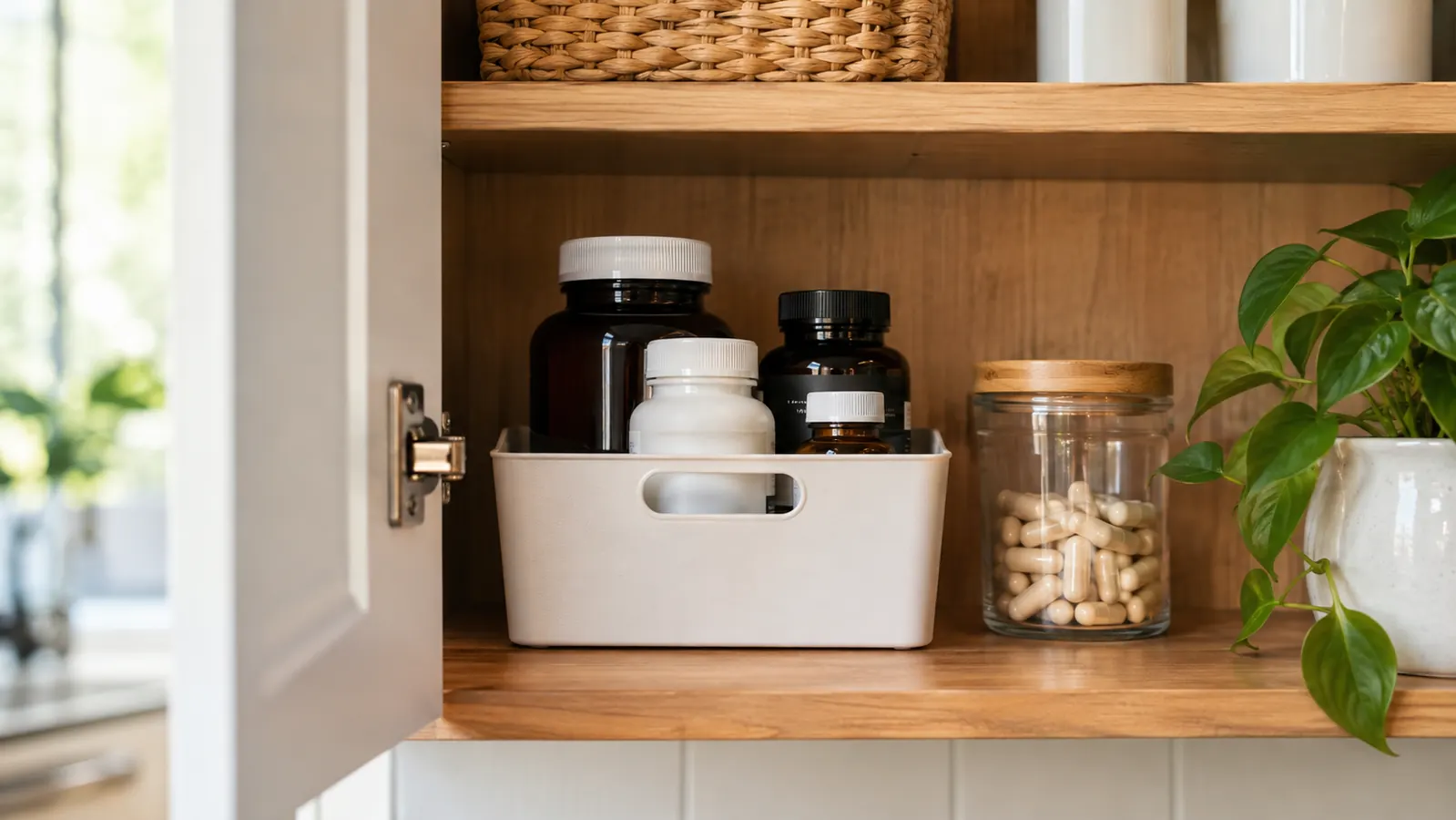
Step 4: Give it a home away from the stove
My supplements live in a small labeled bin in the cabinet to the left of the stove. Left, not above. Above the stove is the hottest, steamiest square foot in the kitchen, and heat is not kind to tablets over months. It is a boring detail and it is part of why the same bottle still looks fine two years in.
The bin is labeled because I am 53 and I got tired of squinting at identical bottles at eight at night. A strip of masking tape and a marker costs nothing. Confusion at eight at night costs a skipped dose.
For travel, the tablets go in a weekly pill organizer. Not the whole bottle, just the week I need. The organizer goes in my bag, and the bottle stays home in the bin. I have never once regretted setting that up the night before a trip instead of in the driveway the next morning.
One more note on the bottle itself: 240 tablets lasts a while, and the container is small, roughly three by three by five inches, so it does not take over a shelf. That sounds like nothing. It matters when four products are sharing one cabinet door.
Step 5: Give it weeks, and write down what you actually notice
This is the step I got wrong the first time. I expected to feel something in three days. When I did not, I decided it was not doing anything and stopped paying attention. That was a mistake, and not because the tablets are magic. It was a mistake because I had no record to compare against.
So I started a note in my phone. One line a week, nothing poetic. Slept through. Up twice. Woke at four and stayed awake. After about six weeks I could read the column back and see something I would not have caught day to day, which is that I was settling down more easily at night. That is my honest observation and it is as far as I will take it. I am not going to tell you it fixed my sleep, because I do not know that, and neither does anyone who has not measured you.
What I can tell you is that the change was small and real, and that small and real is the only kind of change I trust from a bottle that costs what this one costs. The evenings felt less like a transition I had to force. I still wake up sometimes. I still have bad weeks. The note keeps me honest, and honesty is the only reason a routine survives two years.
Two tablets after dinner, the same two tablets for about two years, and my entire claim is that I settle down more easily at night. Anything bigger than that would be me making things up.
What Else Helps
The tablets are one small piece of an evening, and I would be lying if I said they carried it alone. The tea does real work. Not because chamomile is anything special, but because a covered cup steeped for five minutes is a signal that the day is closing. I have been doing that for about four years, and I would keep it if every bottle in the cabinet disappeared tomorrow.
The rest is unglamorous. I take my vitamin D3 with breakfast, not at night, because that is what my doctor suggested and because mornings are when I actually remember. I take turmeric with lunch, with food. I try to be off my feet by ten, which works about half the time and is still better than the years I did not try at all.
Walks help more than any of it. There is a bike path along the lake here, and a long one on a windy day does more for how I sleep than anything I swallow. That is also why my knees got my attention a while back, and why turmeric ended up in the bin. My knees feel better on long walks. That is the whole claim, and I will not dress it up.
If you are deciding between forms of magnesium, the short version is this. Citrate is cheaper and more thoroughly studied, and it does a number on some people's digestion. Glycinate is the one my doctor pointed to for a gentler stomach, and it is the one that stayed in my cabinet. Neither is a sleeping pill, and neither is a substitute for a conversation with your own doctor.
One last thing, and then I will get out of your way. If you are the sort of person who reads the back of the bottle before you read the reviews, good. That habit is worth more than any single product in your kitchen. It is the reason I know what 200 mg per serving means on my own bottle and not just what the front of the box was shouting at me in the store.
Two tablets, one cup of tea, and a bin to the left of the stove
That is the entire routine. Doctor's BEST High Absorption Magnesium Glycinate, 240 tablets, 200 mg per serving, taken after dinner because after dinner is when I am actually home.
Amazon Check Today's Price on Amazon →