

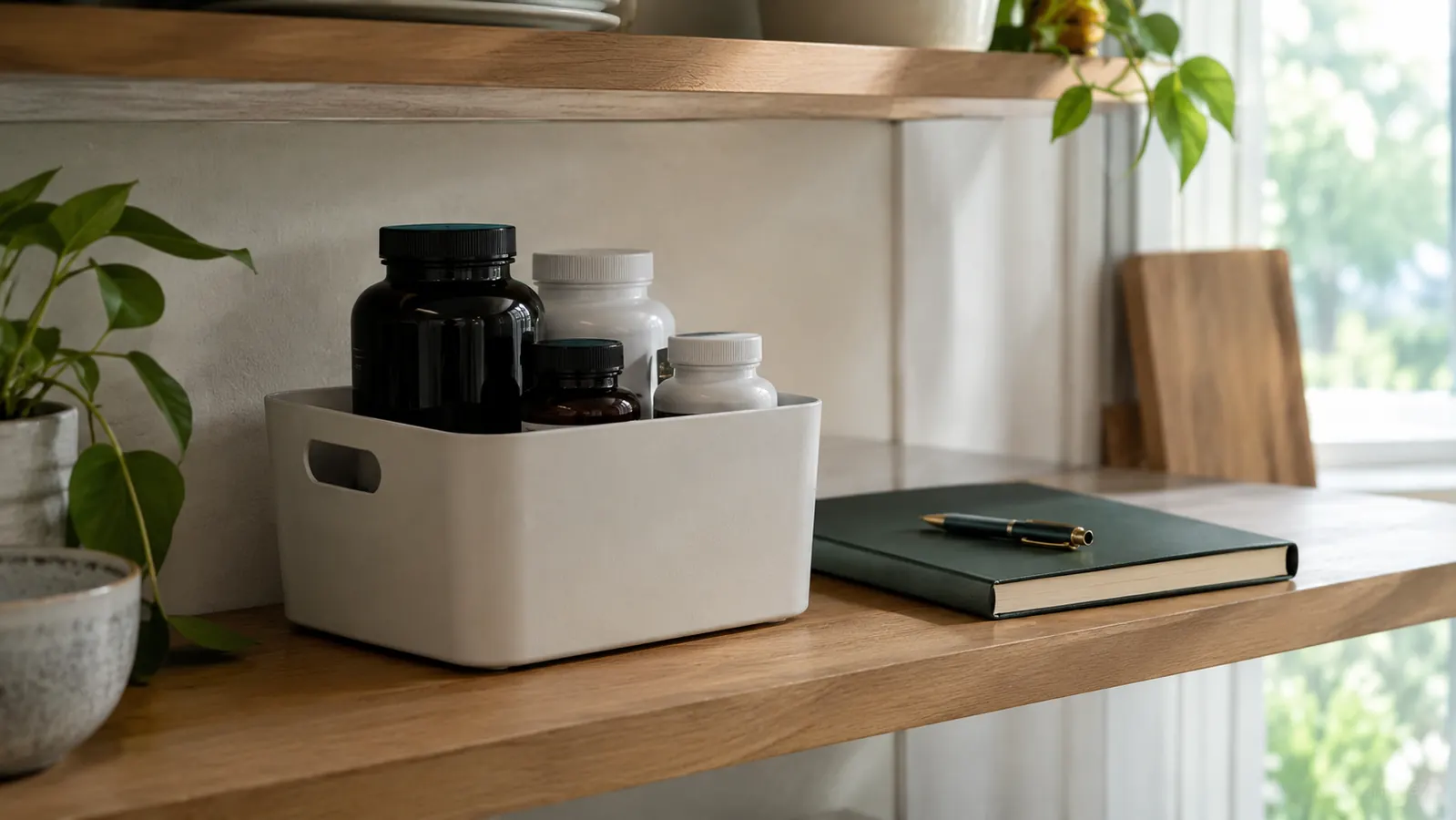
There is a small labeled bin in my kitchen cabinet, to the left of the stove, and the bottle in the front row is NOW Foods Ashwagandha 450 mg. I have opened it every weekday morning for about fourteen months. It is not a dramatic product. Nobody writes a poem about a capsule. But it has earned its spot in the rotation, and I want to tell you exactly why it stayed and exactly where it stops, because a supplement review that only lists the good parts is not a review at all.
I filled a lot of bottles before this one. Calming teas from the co-op. A magnesium powder that tasted like chalk and clumped in the jar. A tincture that came with a dropper and a pamphlet of promises I could not find printed anywhere on the label. What I wanted was quieter, and what I got, mostly, was a smaller cabinet and no answers. So when I started reading about ashwagandha I did what I did for twenty years as a dental office manager: I read the fine print first. NOW Foods made a case I could follow without a marketing degree, and that counted for something.
The Quick Verdict
A plainly labeled, easy to take daily capsule with a clean ingredient statement. Expect a slow, quiet shift rather than a dramatic one, and settle the dose with your own doctor before you start.
Amazon Check Today's Price →Fourteen months, one capsule at breakfast, and no plan to stop
NOW Foods Ashwagandha 450 mg comes in a 90 count bottle of veg capsules, standardized extract, vegan and non-GMO. I take one with breakfast five days a week. The label says one capsule two to three times daily, so read it and let your doctor weigh in on what fits you.
Amazon Check Today's Price on Amazon →How I've Used It
I started in the middle of a hard stretch. My mother moved into assisted living that year, and the paperwork, the phone calls and the drives to see her did not leave room for much else. I brought it up at a regular visit with my doctor, the same appointment where she has been checking my vitamin D once a year since I was in my late forties. She went through what I was already taking, asked a few questions, and told me she did not have a problem with it as long as I stayed at a modest dose and brought the bottle to my next visit. That is the order I do things in now. Doctor first, bottle second.
What I settled on is one capsule with breakfast, around 7:30 in the morning, alongside my vitamin D. Five days on, weekends off. That last part is my own invention, not the label's. The bottle says to take one capsule two to three times daily, so my version is well under what is printed, and I want to be straight about that rather than pretend I am following instructions to the letter. I skip weekends mostly to stretch the bottle a little and because my Saturdays look nothing like my Tuesdays. I have never noticed a difference from the two day gap. I have never noticed much of anything dramatic, which turns out to be the whole story here.
The first month I did what a lot of people do, which is read about it at night, take it in the morning, and look for something. I was checking in with myself every few days like a scientist with an experiment. That is not a useful way to take anything. Somewhere around week six I stopped keeping score and just took the capsule with my vitamin D and got on with the day. I think that is when it started being useful, if it was ever useful at all, and I cannot separate the two.
The mechanics are boring in the best way. The bottle is small, 1.95 by 1.95 by 3.8 inches and about 4.23 ounces, so it stands up in the bin without tipping over when I pull the bin out. The capsules are vegetarian and unflavored, and they go down with half a glass of water without any fuss. I keep the bin away from the stove, because heat and steam are not kind to anything in a capsule, and I travel with a week's worth in a pill organizer. Ninety capsules at my pace lasts me a good while. If you follow the label at three a day, the same bottle is a thirty day supply, which is worth knowing before you decide how you feel about the count.

What's Actually on the Label
Here is what the label and the product listing actually say, since this is the part most reviews skip. Each capsule is 450 mg of ashwagandha as a standardized extract. The bottle holds 90 vegetarian capsules. It is listed as vegan, vegetarian, kosher and halal, and it is made without gluten and without dairy, egg, nut or soy, and it is non-GMO. The recommended use printed on it is one capsule two to three times daily. The manufacturer describes it as an Ayurvedic adaptogen, a general tonic, and points to preliminary data on immune system support.
That last sentence is where I slow down, and you should too. Those claims carry an asterisk, and an asterisk on a supplement label means the statement has not been evaluated by the Food and Drug Administration. That is not a knock on NOW Foods specifically. It is the law for the entire category in this country, and it means nobody, including me, can tell you that a capsule will treat, cure or prevent anything. What you are buying is a clearly labeled botanical extract from a company whose labels I can actually read, not a guarantee.
One more label note that matters to me. The listing mentions an NPA A-rated GMP certification, which means the manufacturing process has been examined and rated. That is a real thing and it is not nothing. But it is a statement about how the capsules are made, not a certificate that a lab tested this specific batch for what it says on the front. I have looked, and I have not found a third party content certificate printed on the bottle. I would like one. I say that as a person who reads insurance policies for fun, so take it with the grain of salt it deserves.
What 14 Months Actually Felt Like
The first three months, nothing. I want to be honest about that because the internet is full of people who feel a profound shift in four days and I am not one of them. I felt exactly the same in the third month as I had at the start. I kept taking it because I had already cleared it with my doctor and because stopping at week six tells you nothing at all. Around the fourth month I started noticing that the hard weeks were still hard, but I was not bracing for them the way I had been. My shoulders were not up around my ears by Wednesday afternoon.
That is a small thing to hang fourteen months on, and I know it. I also take magnesium glycinate in the evening, and I have taken it for about two years, and I have no way to separate what is doing what. Any honest person in my position would tell you the same. There is no blood test for calm. There is no number on a screen that says the capsule is working. What I have is a self report from a 53 year old woman who wanted the winter to be easier, and self reports are the least reliable evidence there is.
So why keep going? Because the effort of continuing is one capsule and eight seconds of my morning, and stopping meant answering a question I did not want to answer during a year that was already difficult. I also noticed that I stopped white knuckling the phone calls. I still do not like making them. I just do not sit in the car for ten minutes first. That is the entire claim I am making, and I am making it carefully.
There is no blood test for calm. What I have is a self report from a woman who wanted the winter to be easier, and I will not dress that up as proof.
The Parts I Don't Love
The dosing bothers me. The label says one capsule two to three times daily, which is a wide range and not much help if you are the kind of person who wants a number. I settled on one, on my own, after a conversation with my doctor, and I am still not sure it is the right one. A bottle that tells you to take it up to three times a day and then gives you 90 capsules is also quietly telling you that the supply depends entirely on which version of the instructions you pick.
The bigger issue is that I cannot prove anything. I am fourteen months in, I have refilled the bottle more than once, and if you asked me to demonstrate a measurable change I would hand you a feeling and a shrug. That is a real limitation and it is the reason I would never tell a friend this is the thing that fixed her. It might be doing nothing. It might be doing something small. Either way it is not a substitute for sleep, for a walk, for a doctor who actually looks at your blood work, or for dealing with the thing that is making the year hard in the first place.
And there is a version of this review where I just tell you it works and you go buy it, and both of us feel good for about a week. I am not going to do that. The most useful thing I can tell you is that a supplement you cannot evaluate is a supplement you have to decide about on other grounds: how clear the label is, how easy it is to take every day, and whether your own doctor is comfortable with it. On those three, this one holds up. On the fourth, the one where you want to know it works, nobody can help you, including the bottle.
What I Liked
- Standardized extract with the milligram amount printed plainly on the front
- 90 vegetarian capsules, vegan, kosher and halal, made without gluten, dairy, egg, nut or soy
- Small bottle that stores easily and capsules that are easy to swallow
- GMP certified manufacturing, which is a real check on the process
- Widely available, so refilling is not a scavenger hunt
Where It Falls Short
- No third party content certificate printed on the bottle that I could find
- The two to three times daily dosing range is vague and leaves the decision to you
- At three capsules a day the bottle is a thirty day supply
- Effects, if any, are slow and impossible to measure
- Not something to start without clearing it with your own doctor, especially if you take medication
Where It Fits in the Cabinet
My routine is deliberately small. Vitamin D3 with breakfast, turmeric with lunch because it has black pepper extract in it and I take it with food, magnesium glycinate after dinner, chamomile and lavender tea most evenings, and the ashwagandha with breakfast five days a week. That is it. I am not interested in a shelf full of bottles, and I have watched friends build one and then abandon it by March. A few things taken at the same time every day beats a dozen things taken whenever you remember.
The reason I kept this one and dropped others is not that it did something spectacular. It is that it did not cost me anything to keep. No aftertaste, no upset stomach, no ritual I had to build around it. That is the bar I use now, and it is a lower bar than the marketing wants you to set. If you are weighing it against a drugstore brand, the two questions worth asking are how the extract is standardized and how many capsules you get for the count, and those answers are on the back of both bottles if you turn them around.
I also think the herb garden behind the house has something to do with why I like the capsule form. I grow mint, chamomile and basil in raised beds, and I make tea out of some of it, and I enjoy that. But I am not steeping roots for a weekday morning at 7:30 while I am also finding my keys. A capsule is a capsule. It is not romantic. It is the reason the routine survives a bad week, and surviving a bad week is the whole job.
Who This Is For
This is for someone who has already talked to a doctor, has a small and steady routine, and wants a plainly labeled adaptogen to try for several months without turning it into a project. It suits people who are fine with slow and unmeasurable, who read the back of the bottle before the front, and who will actually take a capsule at the same time every day. If you are in a genuinely rough stretch and you want something to put in the bin next to the vitamin D while you also address the actual cause, this is a reasonable thing to keep there.
If you are the kind of person who wants a guarantee before you start, I understand that, and I would point you back to your doctor rather than to a bottle. The honest pitch here is not that it works. It is that the label is clear, the capsule is easy, and the downside of trying it for a few months, assuming your doctor agrees, is small. That is a modest thing to say about a product, and it is the most I have got after fourteen months.
Who Should Skip It
Skip it if you are pregnant or nursing, if you take prescription medication of any kind, if you have a thyroid condition or an autoimmune condition, or if you are already on something for anxiety or sleep. Those are conversations for your own doctor and not for a review written by a retired office manager in Vermont. Skip it too if you want proof. If you need a measurable result in two weeks, this will disappoint you, and so will most of what is sold in the supplement aisle. And skip it if you will not take it consistently, because a bottle that sits in the cabinet is just a bottle.
The bottle I stopped questioning somewhere around month six
Ninety veg capsules of standardized ashwagandha extract, vegan, non-GMO, made without gluten, dairy, egg, nut or soy. One capsule with breakfast is my routine. Read the label, talk to your doctor, and give it months rather than days.
Amazon Check Today's Price on Amazon →