

Three winters ago I stood in the supplement aisle at the co-op on North Winooski with a bottle in each hand, reading the back panels and understanding about half of what they said. Ashwagandha was on both labels. One called it an adaptogen. One called it a general tonic. Neither told me when to take it, whether to take it with food, or what to do if I missed a day and only remembered at bedtime.
I am not a doctor, a nutritionist or a pharmacist, and nothing here is medical advice. I am 53, I live in Burlington, Vermont with my husband Paul, and I spent 27 years running the front desk of a dental office before I retired. What I am good at is reading a label closely and asking questions until someone answers them plainly. About 14 months ago, in the middle of a stretch when my mother moved into assisted living and my sleep went sideways, I added NOW Foods Ashwagandha 450 mg to the small labeled bin in the cabinet to the left of my stove. I cleared it with my doctor first. What follows is the routine I actually landed on, in the order I would do it again if I were starting today.
The bottle that lives in the bin to the left of my stove
NOW Foods Ashwagandha 450 mg, standardized extract, 90 veg capsules. One capsule with breakfast, and the back panel tells you the rest. Ask your own doctor before you start.
Amazon Check Today's Price on Amazon →Step 1: Read the back panel before you read the front
The front of a supplement bottle is written by a marketing department. The back is written by whoever has to be accurate. On the NOW Foods bottle the facts are short and unromantic: 450 mg of ashwagandha extract per capsule, standardized, 90 veg capsules in the bottle, and a suggested use of one capsule two to three times daily. That is the whole thing. Four lines that fit on a thumbnail.
The word I look for now is standardized. It means the extract is prepared to a consistent level of a marker compound from batch to batch, so capsule 90 is meant to resemble capsule one. I did not know that a few years ago. I learned it by asking the woman who runs the counter at the co-op, and then by reading the same sentence on four different bottles until it stopped being noise and started being information.
The rest of the panel on this one reads: non-GMO, Kosher, dairy free, egg free, nut free, soy free, vegan and vegetarian, made without gluten, plus an NPA A-rated GMP certification covering the manufacturing process. I cannot tell you what every line of that means. I can tell you that a company willing to print nut free and made without gluten on the back is telling you something about who it expects to be swallowing the thing. And what the label does not say is just as useful. It does not promise better sleep in a headline. It calls ashwagandha a general tonic and adaptogen and mentions preliminary data on immune support. That is a modest claim, and modest claims are the ones I have learned to trust. I also check the serving count, because it is the number that decides whether a bottle lasts a month or a season. 90 capsules, one capsule per serving, 90 servings per container. Follow the panel at two or three a day and you are done inside a month. At my one a day with weekends off, the bottle and I get to know each other. I would rather do that arithmetic in the store than discover it in the middle of a Vermont February.

Step 2: Clear it with your own doctor, and bring the actual bottle
I have a physical every year. A while back my doctor flagged low vitamin D on a routine blood test and suggested a D3 softgel, which is how this whole habit started in the first place. So I already had the practice of putting bottles on the counter before an appointment. When I wanted to ask about ashwagandha, I brought the bottle itself. Not a photo on my phone. Not the name I half remembered from a podcast. The actual bottle, with the panel facing her.
The questions she asked were not the ones I expected. She wanted to know what else I was taking, how I was sleeping, and whether anything had changed in the previous six months. I told her about the magnesium, the tea, my mother, and the fact that I had been waking at four in the morning for weeks on end. She said to try it and tell her at my next visit whether I thought it was doing anything. That was the whole green light, and I appreciated that it came with a follow-up question attached to it rather than a shrug. I wrote her answer on the back of the visit summary in the parking lot, because I have learned that I retain about a third of what is said in an exam room. The note is in my handwriting and it says: try it, tell me in six months, leave the D3 alone. That sheet is still in the notebook on the counter.
If you are pregnant, nursing, or taking prescription medication, that conversation is not optional, and it is not something a blog post can do for you. I am not qualified to tell you whether ashwagandha is safe for you, and I would be doing you a disservice to pretend otherwise. I will say that my pharmacist is easier to reach than my doctor and has never once made me feel foolish for asking.
Step 3: Anchor it to something you already do at the same time every day
A capsule with no time attached to it is a capsule that sits in the cabinet until it expires. I take mine with breakfast, around 7:30 in the morning, which is also when I take the vitamin D softgel. The ashwagandha goes down second, with the last of the coffee.
Here is where I have to be plain with you. The panel says one capsule two to three times daily. I take one capsule, once a day, five days a week, and I take the weekends off. That is not what the bottle says. It was my decision, made with my doctor's knowledge, and it is not a recommendation for you. If you follow the panel instead, you will work through a bottle faster than I do, and you should follow the panel or your own doctor over anything I did.
The anchor matters more than the hour. If 7:30 is when you are standing at the counter waiting for the kettle anyway, put the bottle next to the kettle. If your mornings are chaos, pick the moment you sit down with lunch. What does not work, in my experience, is a plan that asks you to remember something new at a time of day when you are already running late.
Step 4: Give it weeks, not days, and write down the start date
I have been taking it about 14 months. I cannot tell you what it did, and I am wary of anyone who can tell you exactly what a single capsule did inside a life that also contains a mother in assisted living, a Vermont winter, and a husband who snores.
What I can tell you is what I noticed and roughly when. Somewhere around the fifth or sixth week I realized I was getting through the afternoon without the flat, foggy stretch I had come to expect around three o'clock. I cannot prove the capsule did that. I can tell you that I wrote it down, and that those notes are the reason I kept going instead of quitting at day ten like I have with other things. The entry for a Tuesday in that sixth week reads: capsule, breakfast, walked to the co-op and back without stopping at the bench by the library. I am not going to pretend I know what that means. I know I would not have remembered it without the line.
Keep the notes small enough that you will actually keep them. I write the start date on the bottle with a marker and put one line in the notebook on the counter: one capsule, breakfast. A month later, when you are trying to remember whether this is working, that line is worth more than your memory. It is also the first thing your doctor will ask you about.
Step 5: Store it like food, not like decoration
The bin in the cabinet to the left of my stove is not an accident. It is away from the burner and away from the steam that comes off the kettle and the pasta pot. Capsules do not care for heat or moisture, and a bottle that lives on a windowsill above a radiator is a bottle you are wasting one capsule at a time. One July I left a different bottle on the counter through a heat wave and the capsules in the bottom third went soft and stuck together in a single lump. I threw the lot out. It was a cheap lesson and I have only needed it once; the bin has not moved since.
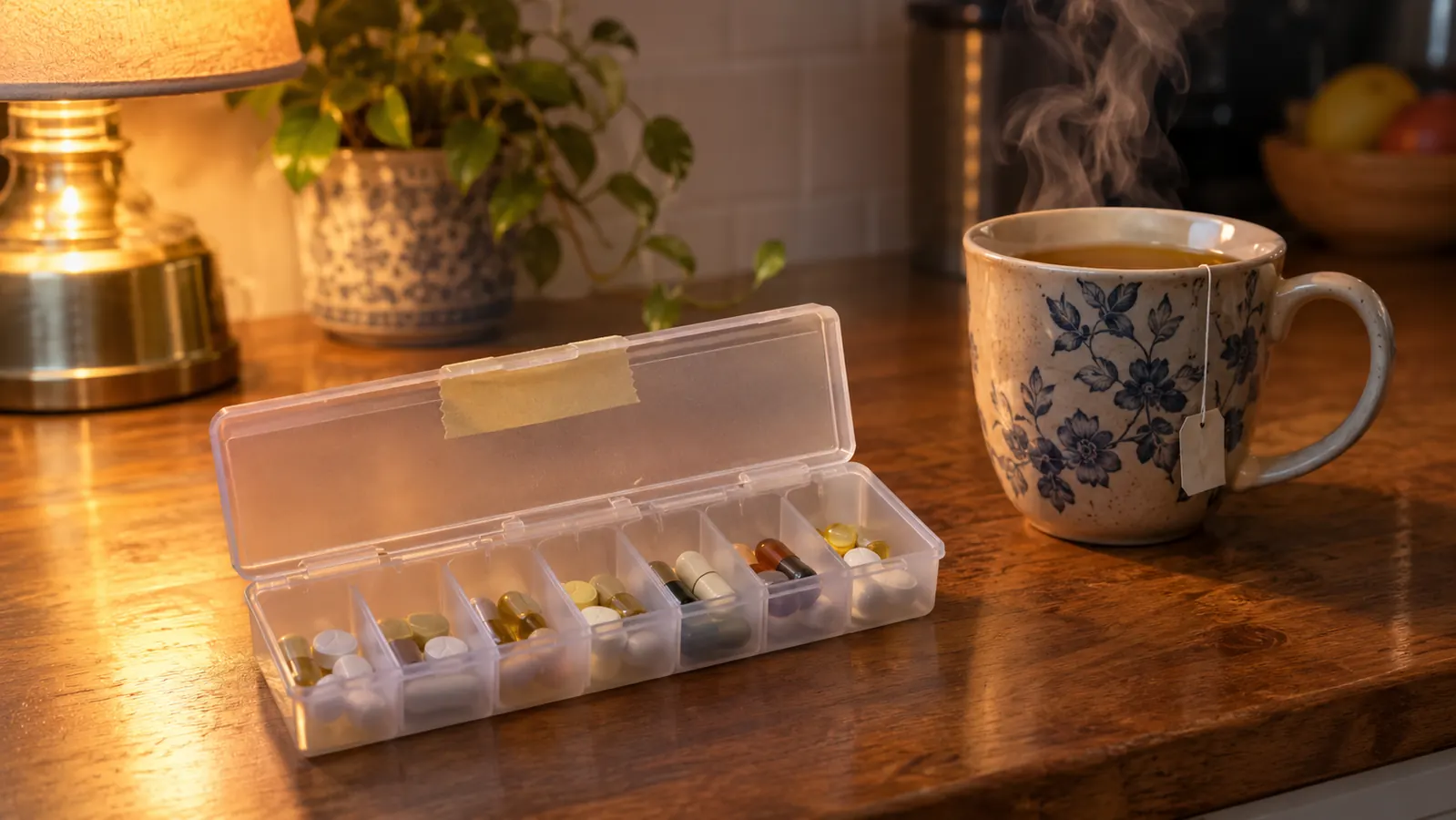
For travel I use a weekly pill organizer. I fill it Sunday evening, put a strip of masking tape on the lid, and write the letters on it in marker. The bottle stays home. The organizer goes in my bag. I have never once been asked about it at an airport, and I have stopped worrying that I will be.
Beyond that, the storage lecture is short. Cap it tight, keep it out of the sun, and do not decant it into anything unlabeled. My mother kept her pills in an unmarked jam jar for years and could not have told you what any of them were. That is the failure mode to avoid, and it takes about four seconds to avoid it.
I have taken one capsule with breakfast, five days a week, for about 14 months. The bottle lives in the bin to the left of the stove. That is the entire system.
What Else Helps
A capsule is one small input among several, and I would be lying if I told you it was the biggest one. The things that changed how I feel most over the past few years were unglamorous. A routine blood test that found low vitamin D. Two magnesium glycinate tablets after dinner, with a glass of water, which my doctor suggested partly because that form tends to be gentler on the stomach than others. I noticed I settle down more easily at night, and I do not claim it fixed anything.
There is also the tea. A cup of chamomile with lavender most evenings after dinner, steeped five minutes with a saucer over the cup to keep the steam in. That habit is four years old, longer than any capsule in the house. It is the one I would keep if I had to give up the rest, because it asks the least of me and it draws a clear line between the working part of the day and the rest of it. Paul drinks coffee at nine at night and sleeps like a stone, which I have given up trying to understand.
And walking. I walk the bike path along Lake Champlain when the weather allows. My knees complained about it for a while, so I added turmeric with lunch, with food, since it has black pepper extract in it. My knees feel better on long walks now. I have no idea which of these things deserves the credit, and at some point I stopped needing to know. That was its own kind of relief.
Start with the panel, not the promise
NOW Foods Ashwagandha 450 mg, standardized extract, 90 veg capsules, vegan and non-GMO. Bring the bottle to your next appointment and ask your own doctor the questions first.
Amazon Check Today's Price on Amazon →