

Three winters ago my doctor read a routine blood test and told me my vitamin D was low. Not alarming low. Low enough, she said, to explain why February always felt like walking through wet sand. I am 53, I live in Burlington, Vermont, and I am not a doctor, a nutritionist or a pharmacist. I am a retired dental office manager who reads labels for fun and asks too many questions. So when she suggested a daily vitamin D3, I went home and read about eleven different bottles before I bought one.
What I landed on is Nature Made Vitamin D3 5000 IU, one softgel with breakfast at 7:30 in the morning, and I have taken it for three winters now. My doctor rechecks my levels once a year. That is the entire routine. But last month my neighbor Denise asked whether she should switch to the liquid drops her sister takes, and I realized I did not have a tidy answer. The honest one is that both forms are vitamin D3, and the real question is not which is better. It is which one you will still be taking in February when you are late for something.
So here is the short answer before the long one. If what you want is a fixed dose you swallow with breakfast, no measuring, no counting, no taste, the softgel is the easier tool and it is not close. If your doctor wants a number the softgels do not come in, or a pill catches in your throat, the liquid drops are the better tool. Neither of those is a marketing position. They are two different jobs, and only one of them is yours.
| Nature Made D3 5000 IU | Liquid D3 drops | |
|---|---|---|
| Form | Softgel, swallowed whole | Oil-based drops from a dropper bottle |
| Dose per serving | 5000 IU (125 mcg) in every softgel | Whatever the dropper releases, counted drop by drop |
| Adjusting the dose | Fixed. Changing it means cutting a softgel or adding a second | Add or remove a drop at a time |
| Measuring | None. The softgel is the dose | Count drops, and drops are easy to lose count of |
| Independent testing | USP Verified mark on the bottle | Varies by brand. Plenty of liquids are not verified |
| Gluten free | Labeled gluten free | Varies by brand and by carrier oil |
| Swallowing | Requires getting a softgel down with water | No pill at all |
| Taking it with fat | You supply the fat. Mine goes down with breakfast | The oil carrier is already in the bottle |
| Travel | Bottle is 2 by 2 by 4.13 inches and the softgels go in a pill organizer | A liquid bottle in a suitcase, with a dropper |
| Best for | A set dose and a set breakfast time | A dose that moves, or a pill that will not go down |
Where Nature Made Wins
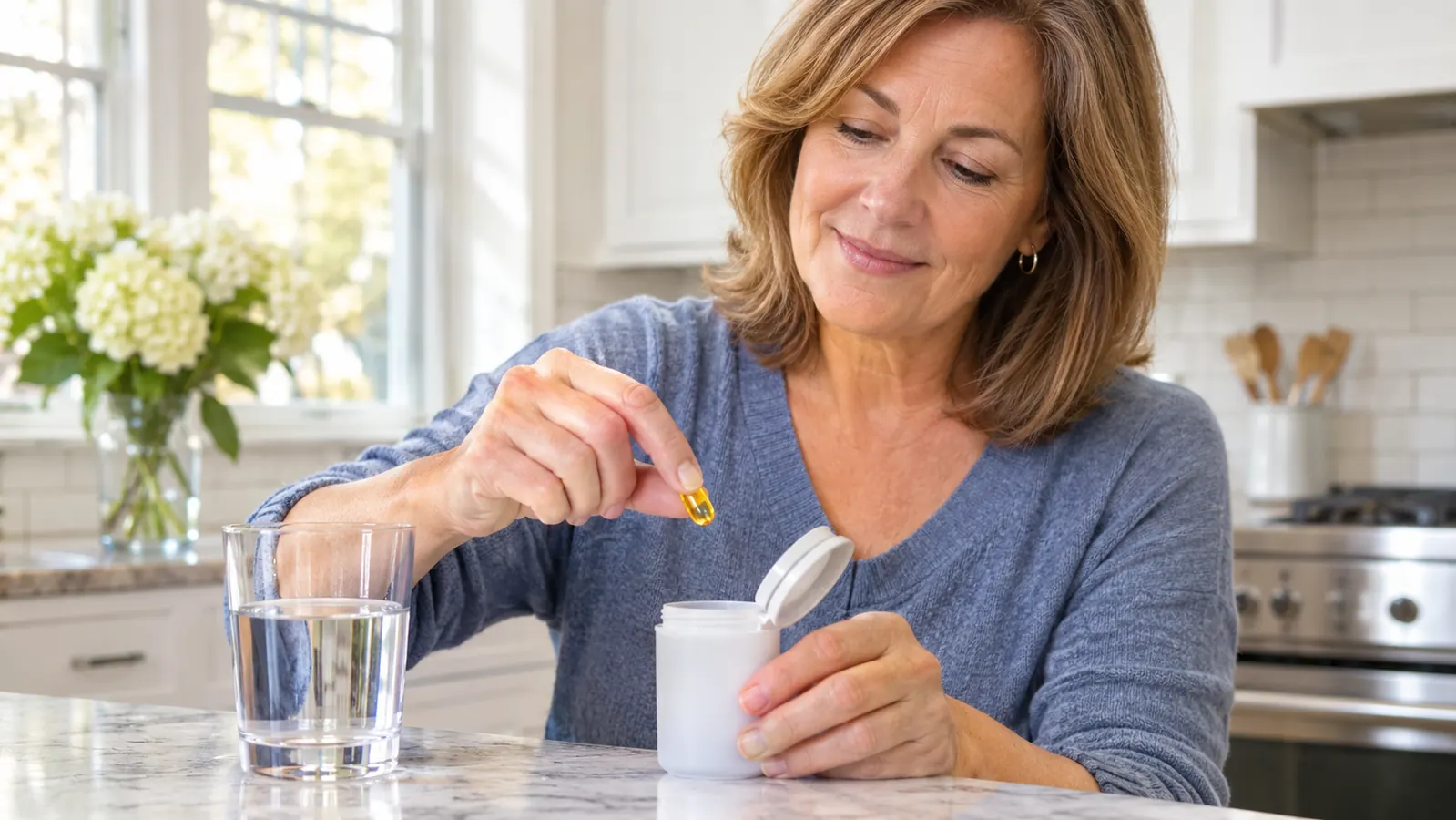
The first thing it wins on is that I never think about it. The softgel is 5000 IU, or 125 mcg, per softgel, and that number is inside the pill, not in my hand. There is no dropper, no counting, no squinting at the side of a little bottle at 7:30 in the morning while the kettle is going. When I worked at the dental office I used to hear people describe a bag of supplements and a story about how they had quietly stopped taking half of them. The ones who kept going were the ones whose routine had the fewest steps. A softgel is one step.
The second thing is the testing. The bottle carries the USP Verified mark, which means an outside group looked at the product rather than just accepting the company's own paperwork. That is not a small detail when you are buying a supplement off a shelf and cannot test it yourself. The label also says gluten free, and the flavor listed is unflavored, so there is nothing to taste and nothing to mix into anything. And the bottle is 2 by 2 by 4.13 inches, small enough that I have never once left it home because it was inconvenient.
Where Liquid D3 Drops Win
Dose flexibility is real and I am not going to pretend otherwise. A drop lets you move in small steps. If your doctor wants you somewhere between what one softgel gives you and what two would give you, a liquid gets closer than a pill you would have to cut with a kitchen knife, badly, on a weekday. For a person whose dose is being adjusted, that is not a minor convenience. It is the whole point.
The other one is swallowing. I have a cousin who cannot get a softgel down without a full glass of water and a certain amount of drama, and for her a dropper is the difference between taking something and not taking it. Liquid D3 also usually comes already suspended in an oil, which is convenient, since vitamin D is fat soluble and my doctor told me to take mine with a meal that has some fat in it either way. With a softgel, that means I actually have to eat breakfast. With drops in oil, the fat is already in the bottle.
Denise's sister pays attention to her drops and I believe her. She keeps the bottle in the refrigerator door and counts eight drops into a spoon every night. When I asked how she remembers the count, she laughed and said she does not always. That is not a reason to avoid drops. It is a reason to know yourself before you buy one, the same way you know whether you are a person who sets a timer or a person who burns things.
The bottle I keep in the bin to the left of the stove
One softgel, 5000 IU (125 mcg), with breakfast. USP Verified, gluten free, unflavored, and 180 to a bottle, which is half a year at one a day.
Amazon Check Today's Price on Amazon →What the Label Actually Says
I am going to be precise here, because this is the part where most write-ups get vague. The bottle is Nature Made Extra Strength Vitamin D3 5000 IU (125 mcg), 180 softgels. Item form is softgel. Flavor is unflavored. The diet type listed is gluten free. The dimensions on the listing are 2 by 2 by 4.13 inches, and the item weight is 0.27 grams, which tells you something about how small the softgel itself is.
I read the back of the bottle in the store before I bought it, which took about a minute. One softgel is a serving. Vitamin D3 is listed as the primary supplement type. 125 mcg, which is the same figure as 5000 IU. 180 servings to the bottle. Nothing on that panel contradicted the front of the bottle, and that alone puts a product ahead of a fair amount of what sits on the same shelf. I have put bottles back for less.
The stated product benefits are bone support and immune system support. I am not going to dress that up, and I am not going to tell you it did anything dramatic for me, because I have no way to know that. My blood test numbers came back in range at my next check, my doctor was satisfied, and that is the honest extent of what I can report. What I can tell you is what I noticed, which is that I stopped dreading February quite so much. Whether that is the softgel, the walks I started taking again, or the fact that I retired, I genuinely could not say.
The listing notes that the softgels are sourced from high quality ingredients, that the product is USP Verified, and that the brand is described as the number one pharmacist recommended vitamin and supplement brand. Those are label claims and I cannot check them from my kitchen. What I can read plainly is that 5000 IU is on the higher end, and the listing itself says this strength is for people with higher vitamin D needs or a deficiency. That is exactly why my first conversation about it was with my doctor and not with a review.
What I wanted was not the strongest bottle on the shelf. I wanted the same small thing at 7:30 every morning, for years, without having to think about it.
The Strength Question
Denise asked me why not just buy the lower dose and take two. It is a fair question, and the answer is that 5000 IU is a specific amount my doctor and I landed on together after a blood test, not a number I picked because bigger sounded better. If you are buying your first bottle with no lab work behind it, I would slow down. A high dose taken casually for years is not the same thing as a high dose taken on purpose with someone checking the result.
When my doctor first raised the number, she asked what I was already eating in a week and whether I got outside at all in the winter. The answer was not much and not often. The 5000 IU was a response to a specific blood result, not a general recommendation for every 53 year old woman in Vermont. Two people my age can need two different amounts and neither of them is wrong. That is why the number on the bottle is the least interesting thing about it.
This is also the one place where the liquid genuinely has an edge that has nothing to do with convenience. If your doctor is adjusting you up or down in small increments, drops give you somewhere to land. If you are on a stable dose and will be for a while, that flexibility is a feature you will never use, and the fixed softgel is simpler for the same reason a one-button radio is simpler than a tuning dial.
How It Fits My Morning
I keep the bottle in a small labeled bin in the kitchen cabinet to the left of the stove, away from the heat and the steam. That is not fussiness. Softgels that live above a stove go sticky by March, and then you have a bottle you do not want to touch, which is a very quiet way to stop taking something you meant to take. At 7:30 I take one with breakfast, usually eggs or toast with butter, and a glass of water. Paul takes his coffee and tells me the news.
There was a morning last March when the power went out and the stove clock was blinking the wrong time, and I still took it, because the bottle is right there at eye level when I reach for the coffee. That is the whole test I run on any habit. If it survives a disrupted morning, it stays. If it needs me to remember it, it does not last.
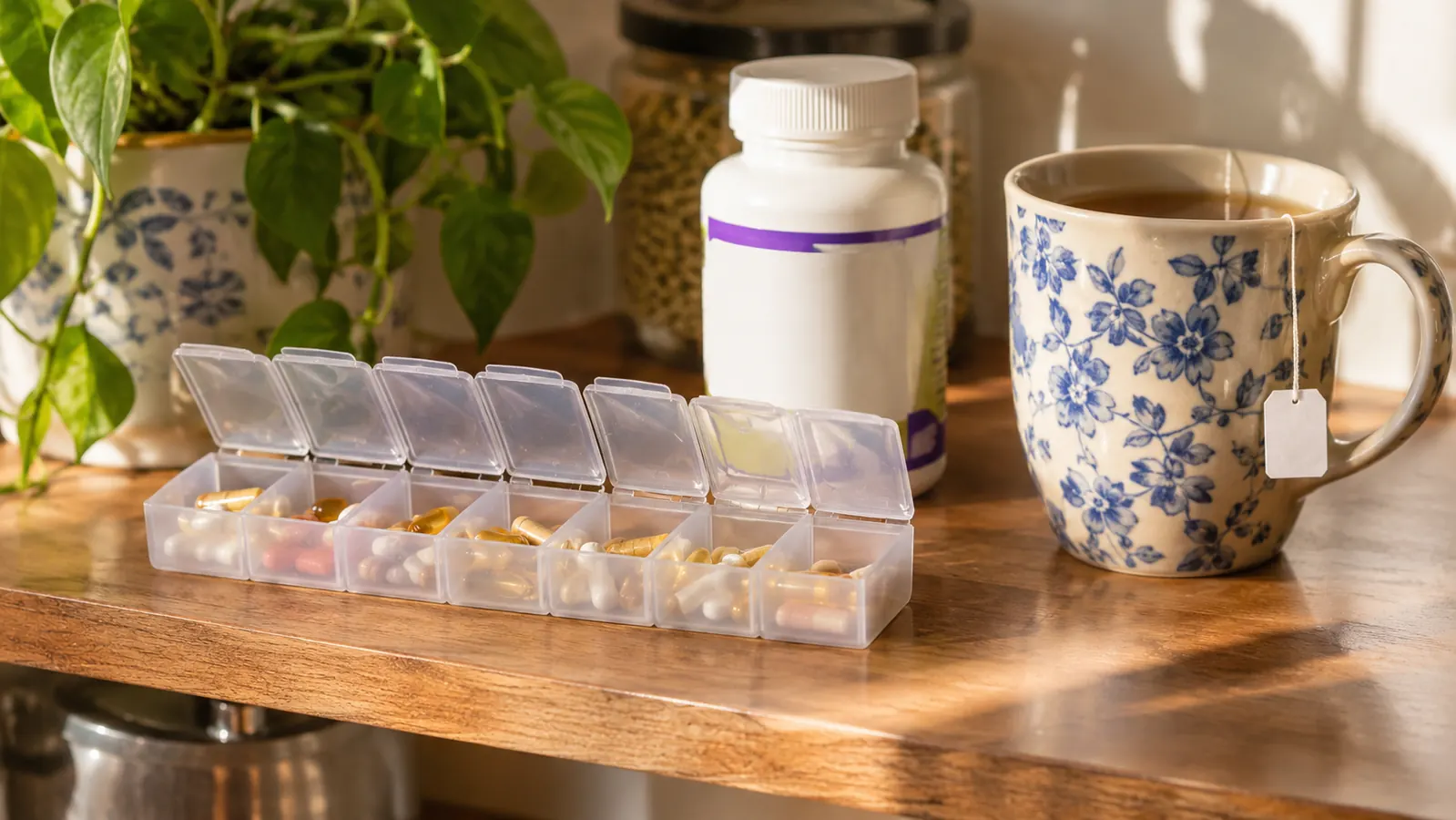
When we travel I count out a week into a pill organizer and leave the bottle home. That is the other place the softgel is easy. It goes in the little box and it does not leak. I have carried a liquid supplement in a suitcase exactly once, and I will not be doing that again. If you have ever opened a bag to find a bottle of oil has been slowly emptying itself onto a sweater, you already understand.
One Question Before You Switch
If you are already taking a vitamin D3 and your levels are where your doctor wants them, the first question is not which form is better. It is whether switching is worth anything at all. Changing a habit that is working is not free. I have taken the same softgel for three winters and I would need a real reason to move, not a convincing paragraph on a website.
If you are starting from nothing, the question gets narrower. Do you want a fixed dose, or do you need to adjust one? Can you swallow a small softgel? Are you usually near a glass of water in the morning? Answer those three and you have your answer. And ask your own doctor first. I mean that plainly. I am an everyday user with strong opinions about labels, not a medical professional, and this matters double if you are pregnant, nursing, or taking any prescription medication.
Who Should Buy Which
Buy the softgels if you want one and done. A fixed 5000 IU per softgel, USP Verified, gluten free, unflavored, 180 to a bottle, in a bottle small enough to live in a cabinet or a suitcase. That fits a person with a set dose and a set breakfast time, which describes most of us who have been told to take something daily and would like to stop thinking about it by Thursday.
Buy the liquid drops if your dose moves, if a softgel is hard to get down, or if your doctor has you on an amount that does not line up with a pill. Those are real reasons and none of them is a knock on either product. The two forms are less rivals than two answers to different questions. Pick the one that survives a bad morning, because a bad morning is the only test that counts.
Three winters in, still the same one softgel
If your doctor has already told you a daily vitamin D3 makes sense for you, this is the bottle in the bin to the left of my stove. One softgel, 5000 IU (125 mcg), with breakfast.
Amazon Check Today's Price on Amazon →