

Three winters ago my doctor looked at a routine blood test and told me my vitamin D was low. Not alarming, she said, just low. She suggested a supplement and told me to come back in a year so she could recheck. That was the whole conversation. She did not hand me a schedule, and I did not ask for one. I drove home thinking about how many bottles I had bought over the years and finished halfway, or not at all.
So I built a routine instead. I am Joanne Pelletier, 53, and I used to manage a dental office in Burlington, Vermont, which means I spent twenty-some years reading fine print on insurance forms for a living. I am not a doctor, a nutritionist or a pharmacist. I am just a person who now reads every label carefully because I have the time and because my own blood test made me pay attention. What follows is how I fit one Nature Made Vitamin D3 softgel into an ordinary morning, plus the honest parts nobody puts on a bottle. Talk to your own doctor before you copy anything I do, especially if you are pregnant, nursing or on prescription medication.
One softgel, one glass of water, and it is done before the coffee finishes
The bottle I keep in the bin to the left of my stove is the 180-count Nature Made Vitamin D3 5000 IU (125 mcg) softgel. Unflavored, gluten free, and small enough that I do not have to think about swallowing it. If you already know your own doctor wants you on D3, this is the one I have taken for three winters.
Amazon Check Today's Price on Amazon →How to Fit Vitamin D3 Softgels Into a Simple Daily Routine
Step 1: Get your own numbers before you buy anything
I did not start with a bottle. I started with a blood test my doctor ordered for other reasons, and the vitamin D result came back low. That detail matters more than any brand name on this page. There is a real difference between taking a supplement because someone online said it was a good idea and taking one because your own doctor looked at your own chart.
The label on the bottle I take says extra strength, 5000 IU, which is 125 mcg. That is a big number. The bottle itself says in plain words that this strength is for people with higher vitamin D needs or a deficiency, as determined by a healthcare professional. Read that twice. It is not a default starting dose for a healthy adult who just wants a little extra.
So step one is boring and unglamorous: ask. My doctor rechecks my levels once a year now, and I bring the bottle to that appointment so she can see exactly what I take. That annual recheck is the reason I feel comfortable taking a 5000 IU softgel at all. Without a doctor watching my numbers, I would not be doing this.

Step 2: Put the bottle where your morning already happens
My first attempt at a supplement routine failed for a completely logistical reason. I kept the bottle in a cabinet across the kitchen, and I did not walk to that cabinet in the morning. Out of sight, out of habit. Three weeks in I noticed a full bottle with three softgels missing.
Now the whole routine lives in one small bin in the kitchen cabinet just to the left of the stove. Not above it. Heat and steam from cooking are not kind to softgels, and a bottle that sits near a boiling pot for years is a bottle I do not trust. The bin is labeled, which sounds fussy until you have stood in front of a cabinet at 7:30 in the morning trying to remember whether you already took something.
Here is the test I use for any new routine: does it live somewhere I already stand? I already stand at the counter making breakfast. So the bin went there. If your mornings happen at a desk, put the bin near the kettle. If they happen in a car, use a small weekly organizer that rides in your bag. The point is not the bin. The point is that the routine should not require a separate trip.
Step 3: Take it with breakfast, food or no food question settled
I take mine with breakfast, around 7:30, with a full glass of water. Vitamin D is fat soluble, which is the phrase that made me start putting it next to food rather than taking it on an empty stomach at 6 a.m. while I was still shuffling around in slippers. My breakfast is not fancy. Yogurt, or eggs, or toast with butter. Something with a little fat in it is enough for me.
I will be careful here, because this is where I am at the edge of what I know. I am not a nutritionist, and I am not going to tell you how absorption works in your body. I will tell you what my own doctor said to me, which was that taking it with a meal was reasonable and easy to remember. Easy to remember turned out to be the part that mattered. A perfectly timed dose you skip is worth less than a good-enough dose you actually take.
One softgel. Unflavored, so there is no aftertaste, which I mention because I am a person who will stop taking something that tastes bad. It is small. On the mornings I am eating while standing up, which is most mornings, I still take it, because the bin is right there and the glass of water is already in my hand.
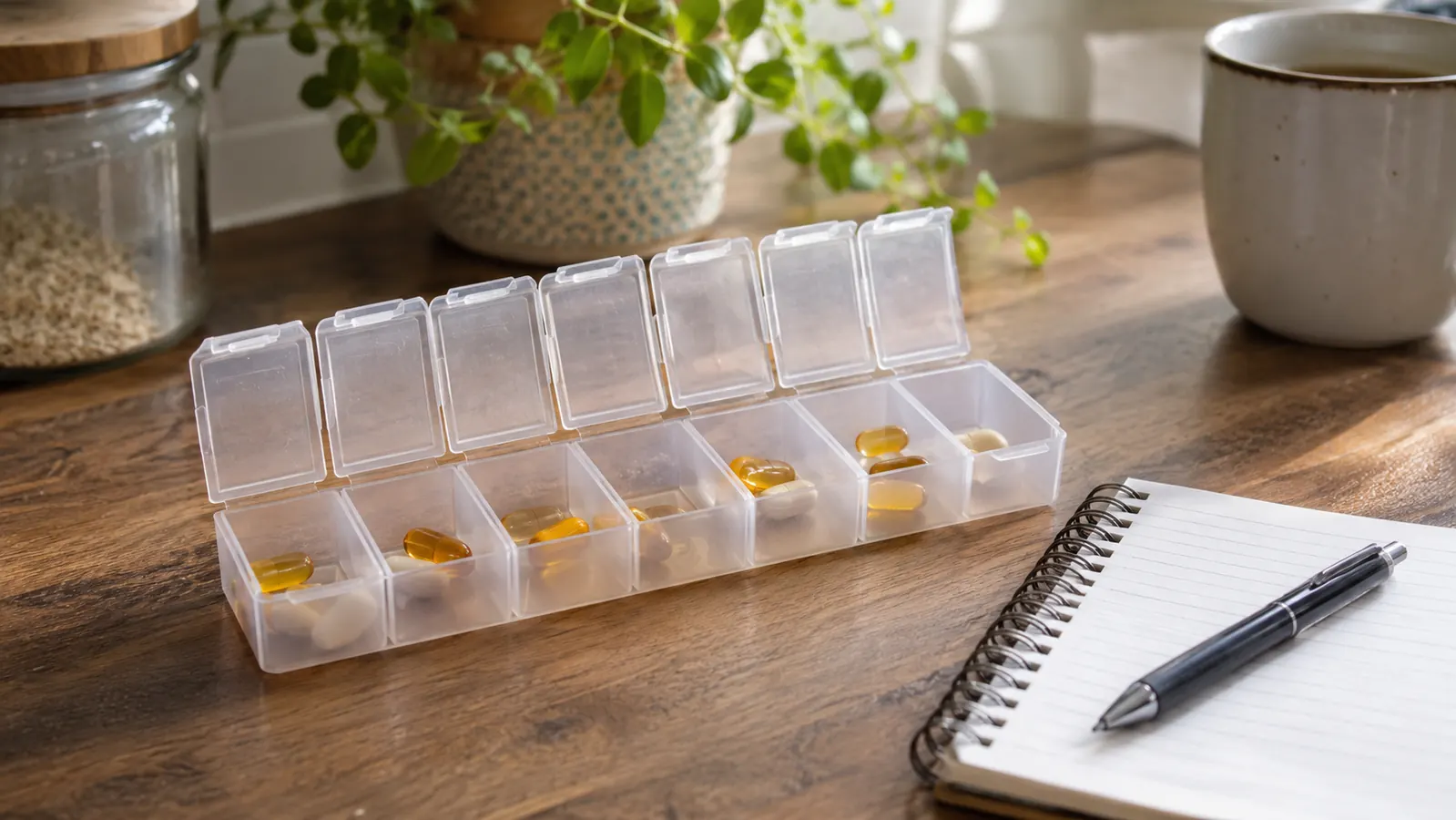
Step 4: Make skipping hard and remembering easy
The single most useful thing I own is not a supplement. It is a weekly pill organizer. I fill it Sunday evening while the kettle heats for tea, and that one chore covers seven mornings. When I travel, which is usually to see my mother in assisted living, the organizer goes in my bag and the bottle stays home.
I also keep a small notebook in the same bin. Nothing elaborate. A line per day. If I open the organizer and Monday's compartment is still full on Tuesday, I know I missed Monday, and I do not double up to compensate. Taking two because you skipped one is not a thing I do, and it is not a thing I would suggest. I just note it and take the next one on schedule.
The other trick is honesty about my own weak spots. I am good at mornings and useless at evenings. That is why the vitamin D3 lives in the morning bin and the magnesium my doctor suggested lives somewhere else entirely. Matching the habit to the hour I am actually reliable has done more for me than any reminder app I ever installed.
A perfectly timed dose you skip is worth less than a good-enough dose you actually take. The bin by the stove beats the perfect plan in my head, every single week.
Step 5: Give it months, then let your doctor's lab test be the judge
This is the step where I see people quit. They take a softgel for eleven days, feel approximately nothing, and decide it does not work. I did the same thing with a different supplement years ago. It is a very human reaction and it is the wrong measurement.
I have taken Nature Made Vitamin D3 for three winters now. I cannot tell you what it feels like to take it, because I do not feel anything when I swallow it. That is not a complaint. It is a supplement that does its work quietly, and the way I know it is doing its job is that my annual blood test stopped coming back low. That is the feedback loop. Not a feeling. A number on a lab report my doctor reads.
So my advice is to set the expectation at roughly a year, because that is how often my doctor rechecks me. Keep the routine boring in the meantime. Take it, note it, move on with your day. If you want my longer account of what three winters of daily use actually looked like, including the parts that did not go smoothly, I wrote it up separately in my Nature Made Vitamin D3 review after long-term use. And if you are weighing a softgel against a dropper, I compared those two in my piece on Nature Made D3 versus liquid vitamin D.
What Else Helps
The softgel is one small piece. What actually changed my winters was a handful of boring things that stack together, and I want to be honest that I cannot separate them out. I take my vitamin D3 with breakfast. I take turmeric with lunch because my knees ached after long walks on the bike path along Lake Champlain, and I will say only that my knees feel better on those walks. I take magnesium after dinner, a form my doctor picked because she said it tends to be gentler on the stomach. Most evenings I make a cup of chamomile and lavender tea, steeped five minutes with a saucer on top, and I have been doing that longer than any of the capsules.
I also cleared everything with my doctor before adding it, one item at a time, not five at once. That is the part I would underline if I were sitting across from you. Adding five things in one week means you learn nothing about any of them, and if something disagrees with you, you have no idea which bottle to blame.
And the unglamorous ones: I get outside on the days the sun shows up in Vermont, which is fewer days than I would like, and I go to bed at roughly the same time most nights. I am not going to pretend those are as easy as swallowing a softgel. They are not. But the softgel is the part I can do reliably in February, and the rest of it is the part I do when I can.
The boring version of a supplement routine is the one that survives February
A labeled bin, one softgel with breakfast, a weekly organizer filled on Sunday, and a doctor who rechecks your numbers once a year. That is the whole system. If your own doctor has already told you that you need D3, the Nature Made 5000 IU softgel is the one I have kept in that bin for three winters. Ask your doctor about the strength first. That part is not optional for me and it should not be for you.
Amazon See the Nature Made Vitamin D3 5000 IU Softgel on Amazon →I will close the way I close every one of these. I am not a doctor, a nutritionist or a pharmacist. I am a 53-year-old woman in Burlington who got a low result on a blood test and built a routine around it, and the routine works for me because it is small enough to keep. Your numbers, your medications and your health are not mine. Talk to your own doctor before you add anything, and if you are pregnant or nursing, that conversation comes before the bottle, not after.